Archive post · Tuba
A Guide to Tuba Mouthpiece Sizes
The reference page for this instrument, tuba: key, transposition, tuning notes and frequencies, is built from published maker and university sources and dated. This post is kept as it was published.
Similar to what happens on other instruments’ mouthpieces, tuba mouthpiece sizes and dimensions can affect the instrument’s sound. And such is related to the distinct forms and sizes of the different parts of a mouthpiece, namely the cup, throat, rim, and backbore.
Tuba mouthpieces come in many different sizes, with the size often denoted by a number.
This article will explain what to consider when choosing tuba mouthpiece sizes.
What Size Tuba Mouthpiece Should I Get?
Many factors determine which size you need such as:
- the type of music you play
- where you play it
- the sound you are willing to achieve
- what’s most comfortable for you to use.
In any case, and if you are not sure about what to get or what you are willing to achieve in terms of sound, always try different mouthpiece sizes until you can find the right fit.
To find the perfect size for you, try out various instruments at stores or online and see which one suits your needs best. If you don’t have access to a store, it’s usually a good idea to purchase something in the middle range for most tuba players because these sizes are likely to suit many different instruments.
Depending on Its Various Parts and the Sound Your Are Willing to Perform with the Tuba
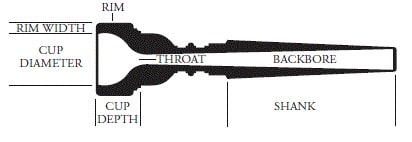 The different parts of a brass instrument mouthpiece
The sizing of tuba mouthpieces and the different dimensions and forms of their various parts will affect how your instrument sounds:
Cup
The volume of the cup, diameter, profile, and depth, affects the sound intensity; Brighter tones can be achieved with shallower and smaller cups, and on the other extreme, larger cup mouthpieces will provide richer and darker tones.
Rim
Generally, for rims, you should look for strength and flexibility, but primarily on how comfortable it feels
If you are looking for more precise sounds, then you should look for narrow and sharper rims. They tend to lead to a lack of resistance. On contrary, if are willing to play for a longer time, then look for round and wider mouthpieces as they are more comfortable to play with. However, those might lack agility, and could be of insufficient tone production.
Throat
Larger Throats increase the volume and the tone. Also increases the blowing freedom and sharpens the higher register. Smaller Throats increase the brilliance of the sound, the endurance, and the air resistance, flattening high register
Shank
The shank is the lengthy portion of the mouthpiece that fits into the instrument receiver. Unlike the other specs defined just above, which vary based upon player choice, shank size is pre-determined by the instrument (though physical adjustments can be made).
Backbores
Wider backbores produce greater sound volume and make it easier to achieve the lower register and they have less resistance. For tighter backbores, expect brighter sounds, good support for higher resistance, and an increase in airflow resistance.
If you are still unsure of what to get, then a medium-sized tuba mouthpiece might be your best option. It allows you to perform in the middle range in terms of sounds, neither too low nor too high.
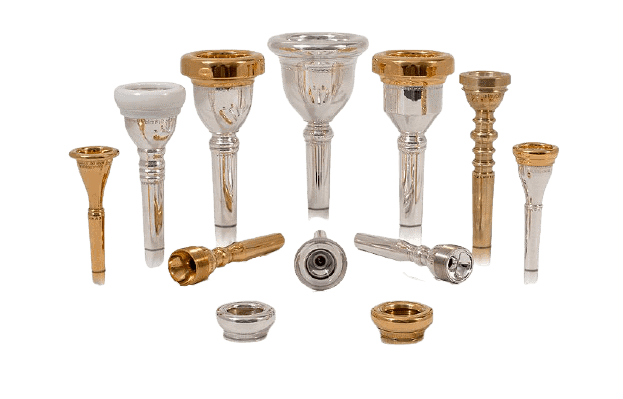 A set of different mouthpieces for brass instruments, including Tuba ones
Tuba Mouthpieces Sizing for Beginners
Generally, if you’re brand-new to playing the tuba or are purchasing a tuba for your student child, then it’s better suggested, to begin with, a small cupped mouthpiece. Because it’s smaller-sized in nature and less complicated to create sound, it’s a suitable choice for those who don’t have a great deal of experience.
On the contrary, if you have experience playing an additional brass instrument or have actually been playing the tuba for a while, it may be much easier for you to experiment with a larger cup.
There are two different designs of tuba mouthpieces. Students often tend to discover that they play much better on one style or the other.
Student Mouthpiece Models Suggestions
Below are some mouthpieces that could be a good start for beginner tuba players, divided between different sizes:
Larger Sizes Student Mouthpiece Models:
- Perantucci 48 (resource link)
- Perantucci 50 (resource link)
Standard Sizes Student Mouthpiece Models:
- Yamaha 66
- Schilke Helleburg
- Denis Wick 3
- Conn Helleberg
- Bach 7 (resource)
The Bach 7 is a mouthpiece style that has a bowl-designed cup as well as is larger around the rim. The Conn Helleburg is a mouthpiece that has a channel-designed cup and is narrower around the rim. Both are great mouthpieces for a tuba beginner player; one fits some learners better than the others. It is a great concept to attempt both as well as see which design is the most effective option for you.
Smaller Sizes Student Mouthpiece Models:
- Bach 12
- Yamaha 68B
- Yamaha 67C4
The Bach 18 and Yamaha 67C4 are popular dimensions, however on the smaller-sized side. They are great dimensions, but students typically do also or better on a Bach 7 or Conn Helleburg. They will certainly often advance that size as they get older unless they relocate to something larger. You would assume the tuba would certainly be less complicated to have fun with a smaller-sized mouthpiece, yet commonly it is not. Nonetheless, if a pupil seems wonderful on another thing, let them play it.
Keep in mind that some are not “student” mouthpieces, but they are great sizes for students. Many professional players utilize these same mouthpieces.
Whatever mouthpiece you select, it is always the produced sound and how comfortable you are playing it, not the dimension, that matters most!
Comparison Chart of Tuba Mouthpiece Sizes
We’ve gathered a list of the sizes of some of the most common tuba brands and manufacturers’ mouthpieces. They might differ a bit from the actual dimensions but are gathered through each brand’s website or literature.
Brand
Model
Rim (mm/inches)
Cup Depth
Rim Width
Throat
Backbore
Yamaha
64
30.45 / 1.199″
Medium
Thick
8.35mm
Standard
Yamaha
65
30.95 / 1.219″
Medium
Semi-thin
8.35mm
Semi-wide
Yamaha
66
31.37 / 1.235″
Deep
Standard
8.35mm
Standard
Yamaha
66B
31.37 / 1.235″
Shallow
Standard
8.35mm
Semi-wide
Yamaha
66D4
31.49 / 1.240″
Deep
Medium-Wide
8.87mm
Semi-wide
Yamaha
67
31.93 / 1.257″
Medium
Medium
8.35mm
Semi-wide
Yamaha
Bobo TT
32.04 / 1.261″
Shallow
Medium
7.02mm
Standard
Yamaha
67C4
32.06 / 1.262″
Medium
Medium-Wide
8.1mm
Standard
Yamaha
67B4
32.06 / 1.262″
Shallow
Medium-Wide
7.02mm
Standard
Yamaha
Bobo Solo
32.20 / 1.268″
7.5mm
Yamaha
Canadian Brass
32.28 / 1.271″
8.55mm
Yamaha
68B
32.72 / 1.288″
Shallow
Medium-Wide
7.5mm
Standard
Yamaha
Jim Self
32.86 / 1.294″
8mm
Yamaha
Bobo Sym
32.90 / 1.295″
7.5mm
Schilke
66
31.52 / 1.241″
Schilke
S-H
31.84 / 1.254″
Schilke
62
31.85 / 1.254″
Schilke
67
32.41 / 1.276″
Schilke
69C4
32.76 / 1.290″
Kelly
24AW
31.50 / 1.240″
9.05
8.6mm
Kelly
18
31.80 / 1.252″
7.75
8.6mm
Kelly
Kellyberg
31.85 / 1.255″
Joseph Klier
T9-C
30.00 / 1.181″
8
8mm
Joseph Klier
T9-D
30.00 / 1.181″
8
7.8mm
Joseph Klier
T9-E
30.00 / 1.181″
8
7.8mm
Joseph Klier
T8-B
30.50 / 1.201″
8.25
8.2mm
Joseph Klier
T8-C
30.50 / 1.201″
8.25
8mm
Joseph Klier
T8-D
30.50 / 1.201″
8.25
7.8mm
Joseph Klier
T8-E
30.50 / 1.201″
8.25
7.8mm
Joseph Klier
25
31.00 / 1.220″
7.85
8.6mm
Joseph Klier
T7-A
31.00 / 1.220″
8
8.4mm
Joseph Klier
T7-B
31.00 / 1.220″
8
8.2mm
Joseph Klier
T7-C
31.00 / 1.220″
8
8mm
Joseph Klier
T7-D
31.00 / 1.220″
8
7.8mm
Joseph Klier
T7-E
31.00 / 1.220″
8
7.8mm
Joseph Klier
T6-A
31.50 / 1.240″
8.25
8.4mm
Joseph Klier
T6-AA
31.50 / 1.240″
8.25
8.6mm
Joseph Klier
T6-B
31.50 / 1.240″
8.25
8.2mm
Joseph Klier
T6-C
31.50 / 1.240″
8.25
8mm
Joseph Klier
T6-D
31.50 / 1.240″
8.25
7.8mm
Joseph Klier
T6-E
31.50 / 1.240″
8.25
7.8mm
Joseph Klier
24W
31.50 / 1.240″
9.05
8.6mm
Joseph Klier
T5-A
32.00 / 1.260″
8
8.4mm
Joseph Klier
T5-AA
32.00 / 1.260″
8
8.6mm
Joseph Klier
T5-B
32.00 / 1.260″
8
8.2mm
Joseph Klier
T5-C
32.00 / 1.260″
8
8mm
Joseph Klier
T5-D
32.00 / 1.260″
8
7.8mm
Joseph Klier
T5-E
32.00 / 1.260″
8
7.8mm
Joseph Klier
T4-A
32.50 / 1.280″
8.25
8.4mm
Joseph Klier
T4-AA
32.50 / 1.280″
8.25
8.6mm
Joseph Klier
T4-B
32.50 / 1.280″
8.25
8.2mm
Joseph Klier
T4-C
32.50 / 1.280″
8.25
8mm
Joseph Klier
T4-D
32.50 / 1.280″
8.25
7.8mm
Joseph Klier
T4-E
32.50 / 1.280″
8.25
7.8mm
Joseph Klier
T3-A
33.00 / 1.299″
8
8.4mm
Joseph Klier
T3-AA
33.00 / 1.299″
8
8.6mm
Joseph Klier
T3-B
33.00 / 1.299″
8
8.2mm
Joseph Klier
T3-C
33.00 / 1.299″
8
8mm
Joseph Klier
T3-D
33.00 / 1.299″
8
7.8mm
Joseph Klier
T3-E
33.00 / 1.299″
8
7.8mm
Joseph Klier
T2-A
33.50 / 1.319″
8.25
8.4mm
Joseph Klier
T2-AA
33.50 / 1.319″
8.25
8.6mm
Joseph Klier
T2-B
33.50 / 1.319″
8.25
8.2mm
Joseph Klier
T2-C
33.50 / 1.319″
8.25
8mm
Joseph Klier
T2-D
33.50 / 1.319″
8.25
7.8mm
Joseph Klier
T2-E
33.50 / 1.319″
8.25
7.8mm
Joseph Klier
T1-A
34.00 / 1.339″
8
8.4mm
Joseph Klier
T1-AA
34.00 / 1.339″
8
8.6mm
Joseph Klier
T1-B
34.00 / 1.339″
8
8.2mm
Joseph Klier
T1-C
34.00 / 1.339″
8
8mm
Joseph Klier
T1-D
34.00 / 1.339″
8
7.8mm
Joseph Klier
T1-E
34.00 / 1.339″
8
7.8mm
Denis Wick
5
30.00 / 1.181″
7.14
7.89mm
Denis Wick
5L
30.00 / 1.181″
7.14
7.89mm
Denis Wick
4
30.50 / 1.201″
6.89
8.27mm
Denis Wick
4L
30.50 / 1.201″
6.89
8.27mm
Denis Wick
3
31.25 / 1.230″
8.11
8.78mm
Denis Wick
3L
31.25 / 1.230″
8.11
8.78mm
Denis Wick
3SL
31.25 / 1.230″
8.11
7.62mm
Denis Wick
3XL
31.25 / 1.230″
8.11
8.78mm
Denis Wick
2
32.00 / 1.260″
7.73
8.45mm
Denis Wick
2L
32.00 / 1.260″
7.73
8.45mm
Denis Wick
2SL
32.00 / 1.260″
7.73
8.45mm
Denis Wick
2XL
32.00 / 1.260″
7.73
8.45mm
Denis Wick
1
32.50 / 1.280″
7.48
8.43mm
Denis Wick
1L
32.50 / 1.280″
7.48
8.43mm
Denis Wick
1XL
32.50 / 1.280″
7.48
8.43mm
Conn
7B Helleberg
31.50 / 1.240″
Medium
8.3mm
8.5mm
Conn
120S Helleberg
32.50 / 1.279″
Medium
7.3mm
8.1mm
Blessing
24AW
31.25 / 1.230″
Deep
Wide
8.84mm
810
Blessing
18
32.10 / 1.264″
Medium
Medium-Wide
8.84mm
810
Bach
32E
29.50 / 1.161″
Shallow
Medium-Wide
8.33mm
801
Bach
30E
30.00 / 1.181″
Shallow
Medium-Wide
8.33mm
801
Bach
25
30.60 / 1.205″
Medium
Medium-Wide
8.33mm
801
Bach
24W Mega
31.25 / 1.230″
Medium
Wide
9.00mm
810
Bach
24AW Mega
31.25 / 1.230″
Deep
Wide
8.84mm
810
Bach
24W
31.25 / 1.230″
Medium
Wide
8.84mm
810
Bach
24AW
31.25 / 1.230″
Deep
Wide
8.84mm
810
Bach
22 Mega
31.60 / 1.244″
Medium
Medium-Wide
8.62mm
801
Bach
22
31.60 / 1.244″
Medium
Medium-Wide
8.62mm
801
Bach
18 Mega
32.10 / 1.264″
Medium
Medium-Wide
9.00mm
810
Bach
18
32.10 / 1.264″
Medium
Medium-Wide
8.84mm
810
Bach
12 Mega
32.75 / 1.289″
Medium
Medium-Wide
8.62mm
801
Bach
12
32.75 / 1.289″
Medium
Medium-Wide
8.33mm
801
Bach
7
33.25 / 1.309″
Medium
Medium-Wide
8.33mm
801
Bach
7 Mega
33.25 / 1.309″
Medium
Medium-Wide
9.00mm
801
A list of different tuba mouthpieces and their sizes from different brands and models
(data gathered from each brand)